A construction gate is not a spotless office lobby. Workers arrive in groups, wear helmets and reflective vests, carry tools, and sometimes enter a site whose network coverage is weak. The check-in experience must respect those conditions rather than assume every face will be framed like a studio portrait.
An authorized worker can use an assigned phone or a standard tablet fixed securely beside the site entrance. The primary objective is a reliable attendance record linked to the correct worker, contractor and site, not an unsupported promise of automatic safety compliance.
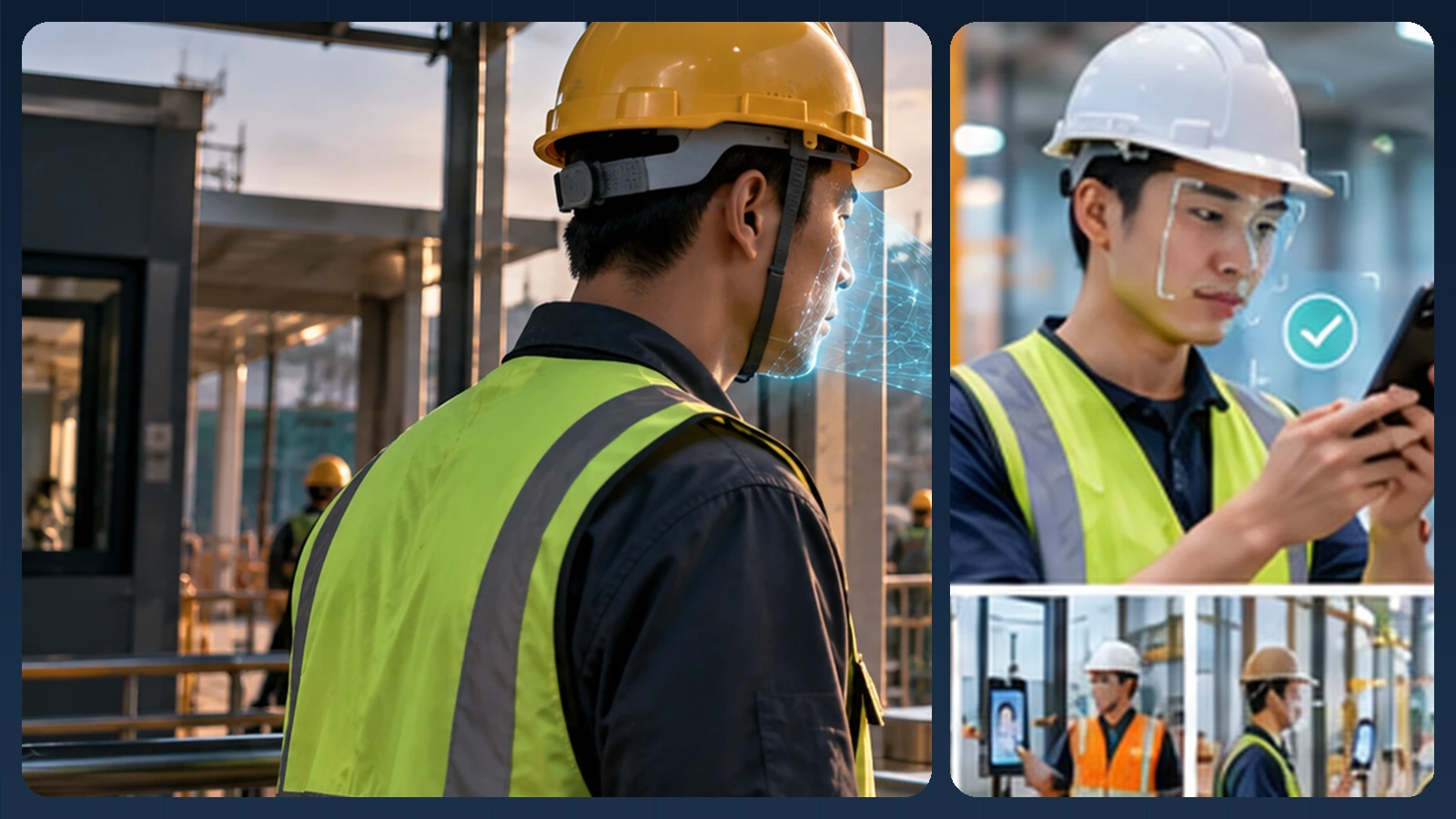
Editorial illustration of a possible experience. Actual UI, device mounts and integrations vary.
A crew arrives while equipment is already moving
A contractor supervisor walks through the gate and checks in on a phone. Two workers behind use a ruggedized mount holding an approved tablet, taking turns for an intentional capture. Another subcontractor arrives later and is verified only against the site-scoped list of people allowed there. A site manager sees exceptions requiring review instead of treating every missed scan as misconduct.
PPE matters: helmet brims, dust, glare and poor weather can affect image quality. Use a safe capture point away from vehicle movement. The check-in should not require removing mandatory protective equipment if that would create a hazard. If a face cannot be captured reliably, provide an approved non-biometric or assisted path. Attendance status and permission to operate hazardous equipment are different checks.
How the identity step connects to the business workflow
A practical implementation separates the camera interaction, the biometric result and the final business decision. AttFace Core can perform face detection, quality-related analysis, liveness checks where selected, and 1:1 verification or scoped 1:N identification. The partner application decides how to act on those results. Successful face matching alone does not grant access, certify attendance, authorize a transaction or resolve a disputed event.
Conceptual architecture, not a product screenshot or a statement that all pictured integrations are already deployed.
The operational problem: many employers, one site
A principal contractor may coordinate electrical, structural, mechanical and finishing teams. Each subcontractor manages its own employees, while the site operator maintains the access rules. A worker can be authorized for one location or phase of work and ineligible for another.
This suggests a controlled identity lifecycle:
- Onboard the worker. Establish identity, link to the correct contractor and obtain required notices and enrollment permissions.
- Validate site eligibility. Confirm dates, induction status, training, contractual access and any required certifications before a person is allowed through the gate.
- Verify at the gate. Use an appropriate 1:1 or narrowly scoped 1:N check under realistic capture conditions.
- Create the site event. Record arrival or departure with a facility and gate identifier, timestamp and event status.
- Reconcile and report. Provide authorized dashboards to site administration and contractors with properly separated data access.
A better gate design starts with safety
Outdoor lighting, rain, dust, glare and camera placement can be harder than the recognition model itself. Helmets, glasses and respiratory protection may obscure parts of the face. A biometric gate must not require anyone to remove PPE where doing so would be unsafe. Provide an alternate verification method, ideally in a sheltered, designated area away from vehicle traffic.
Multiple people passing the camera simultaneously can create ambiguous detections. Clear capture markings and one-at-a-time guidance are usually better than attempting a best-guess match in a crowd. Choose mounting heights that accommodate a range of users.
The door controller, emergency egress and site safety systems need an independent design. A network or biometric failure should not compromise required evacuation routes or site emergency procedures.
Face recognition is one step in a wider access decision
A match establishes a potential identity. It does not prove that the person has completed a site induction, holds an active permit or belongs to an approved subcontractor. Those conditions belong in the site access policy engine or construction management platform.
Illustrative integration workflow. Site controllers, training databases and contractor systems vary by project.
A useful design separates the face engine from the site database, rule engine, controller and event log. This makes it easier to change an identity provider, add a new subcontractor, or revoke site privileges without rewriting recognition logic.
Moving teams between sites
Multi-site contractors raise a data governance question. Does the employer own worker identities, does each project enroll people independently, or is there an authorized central identity with site-scoped permissions? The answer should be explicit before deployment.
Avoid copying every worker's biometric template to every site by default. Use site-limited galleries and strict administrative permissions. For offline gates, document how current local credentials are, how revocation propagates, and what happens when the network is unavailable.
When a contract ends, site permissions must be removed promptly. Biometric retention and event-retention periods may legitimately differ; document both and make deletion feasible.
Practical pilots and success measures
A pilot should run during peak morning arrival, when queues have real operational cost. Evaluate capture completion with permitted PPE, average and high-percentile transaction time, blocked or uncertain checks, and the time required to correct a record without penalizing the worker.
Also verify that access decisions respect inductions and authorization expiry. A system that recognizes the right person but grants the wrong permission is not secure. Test night shifts, weather transitions and network failures before extending to additional sites.
Business outcomes can include cleaner contractor attendance records and faster reporting, but should be measured rather than promised. A “verified” face is not evidence of productivity, safety compliance or hours worked beyond the recorded transaction.
What is available today, and what needs integration
AttFace Core can supply detection, quality assessment and verification inside a contractor-management platform. AttFace Attendance can be considered for workforce-style check-in on supported devices, but contractor onboarding, certifications, gate controllers and safety compliance must be integrated or managed separately. Do not present a construction image as proof that a particular ruggedized device has been certified with AttFace.
Build the pilot around everyday people and devices
Test the real touchpoints shown in this story: a personally assigned phone, a wall-mounted phone or tablet, and a slim floor stand where appropriate. Include bright windows, colleagues walking together, glasses or PPE where relevant, a failed first capture, and a network interruption when the architecture permits local processing. Record first-attempt completion, retries, recovery time, auditability and administrator corrections—not just a face match score.
Make the next action explicit when image quality or identity confidence is uncertain. A repeat capture, a claimed-ID 1:1 flow, or an authorized assisted alternative is generally more responsible than quietly lowering the threshold. Document data retention, consent or other lawful basis, deletion and access controls for the deployment's jurisdiction.
Next step. Building a site-management or contractor platform? Contact AttFace to scope a safe, real-world phone/tablet pilot.