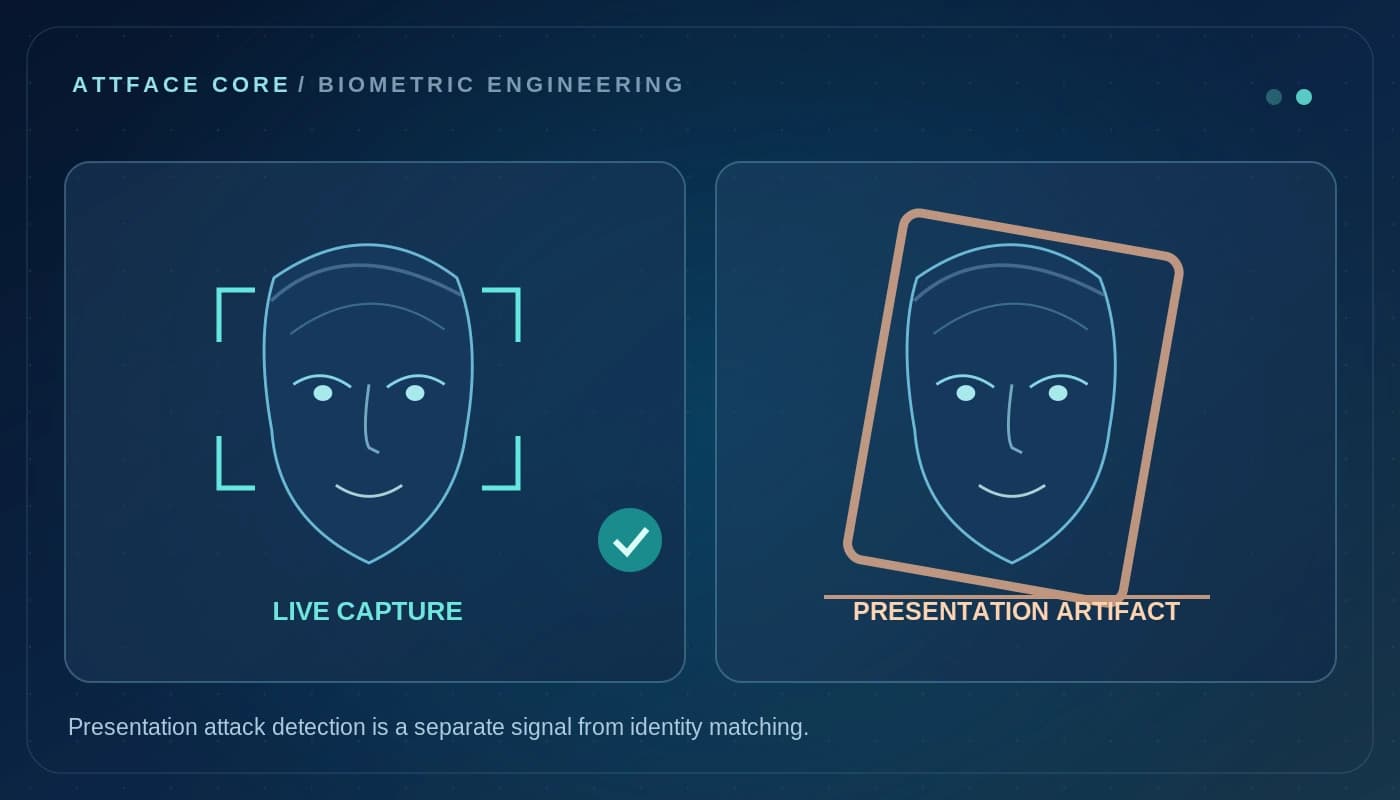
A user may be authenticated when they sign in, but the system can still need more assurance before a consequential action. Changing a payout destination, approving a high-value transfer, modifying privileged access or releasing a restricted document can justify a new check tied to that exact operation.
Face verification can contribute an additional signal. It should not be sold as a standalone guarantee of identity, an alternative to authorization, or a substitute for strong possession-based authenticators and device integrity controls.

Concept illustration; not a real AttFace UI, verified identification result or customer deployment.
Think in terms of a transaction, not another login
Imagine an operations manager approving a sensitive configuration change. The session is already protected by the company's usual authentication stack. When the manager confirms the high-impact action, the application binds the request to its transaction ID, checks permissions and risk indicators, and may request a short, explained face verification against the manager's enrolled reference.
If the face capture fails, the system does not automatically label the manager an attacker. It can pause the action, request a different permitted factor, or route it through an authorized escalation path.
Suggested security architecture. The face step is one component of an application-owned, risk-based authorization decision.
Why a green match is not enough
A face match is an estimate of similarity under a specific model, threshold and capture condition. It does not prove that a session token was not stolen, that a device was not compromised, or that an administrator is authorized to approve the operation.
The application must independently validate authorization, transaction integrity and session freshness. Presentation attack detection helps address certain spoofing attempts, but endpoint compromise and injection threats require their own controls.
The US NIST digital identity guidance is a useful reference for high-assurance authentication design. It describes biometrics as part of a broader multi-factor framework with constraints and alternatives—not as a single secret that safely replaces all other factors. The product's actual regulatory obligations depend on the deployment context.
Design the sequence to match risk
Not every action needs a new biometric prompt. Requiring a face check for trivial operations creates fatigue and unnecessary data collection. Trigger step-up verification at clear risk boundaries, such as a sensitive change or anomalous account-recovery attempt.
For some actions, two-person approval or a hardware-backed key may be more appropriate than adding another biometric step. Decide with the security owner which control answers the actual threat model.
Keep enrollment and evidence governed
Enrollment needs to be tied to an established identity, not to a self-selected face image during the same high-risk transaction. Protect biometric templates, limit who can replace them, log enrollment changes and make revocation straightforward.
Audit logs should include the decision path and policy version without indiscriminately storing raw face imagery. Make sure the application can reconstruct why an operation was approved or escalated without leaking sensitive artifacts into general business analytics.
Evaluate the whole operation
Pilot metrics should include false denials, fallback frequency, transaction latency, user completion rate and review outcomes. A face pipeline can perform well in a benchmark and still fail the product if users cannot complete time-sensitive actions or if the approval policy is poorly specified.
Bind the check to the sensitive action
A face step performed five minutes ago should not automatically authorize any transaction in the same browser tab. The security design can associate an approval with a specific action, amount, destination or configuration change and a short validity period. The server should validate that the operation presented to the user is the one actually executed.
This is why a credible architecture separates identity verification, session controls and the authorization engine. Different components answer different questions, and their evidence should be recorded without treating a match score as permission.
Plan for emergencies and recovery
Organizations need a route for urgent work when cameras fail or staff cannot provide a suitable capture. Define break-glass procedures, dual control or alternative strong authenticators appropriate to the environment. Such paths require monitoring and audit review; they should not be secret bypasses added after the biometric pilot launches. Security engineers should threat-model both the normal and fallback branches.
Build this into an existing security platform
AttFace Core can support the biometric verification portion of a partner's approval, IAM or privileged-workflow product. The partner remains responsible for session security, strong authentication, authorization, risk decisions and audit governance.
Explore AttFace Core with AIPractix if your system needs a risk-based face verification component inside a broader security architecture.