A good identity system does not ask “How many AI models can we combine?” It asks “What evidence is needed for this action, which evidence is practical here, and how should the application respond if the evidence is incomplete?”
That is the design principle behind multimodal verification. Face recognition may be the primary biometric method. A potential palm method could be introduced as an alternative or additional signal for certain users and environments. Device possession, verified account context and strong authenticators can provide separate forms of assurance.
Product status: The face pipeline is the current AttFace Core focus. Palm and cross-modal decision fusion in this article are forward-looking design concepts, not released features or tested performance results.
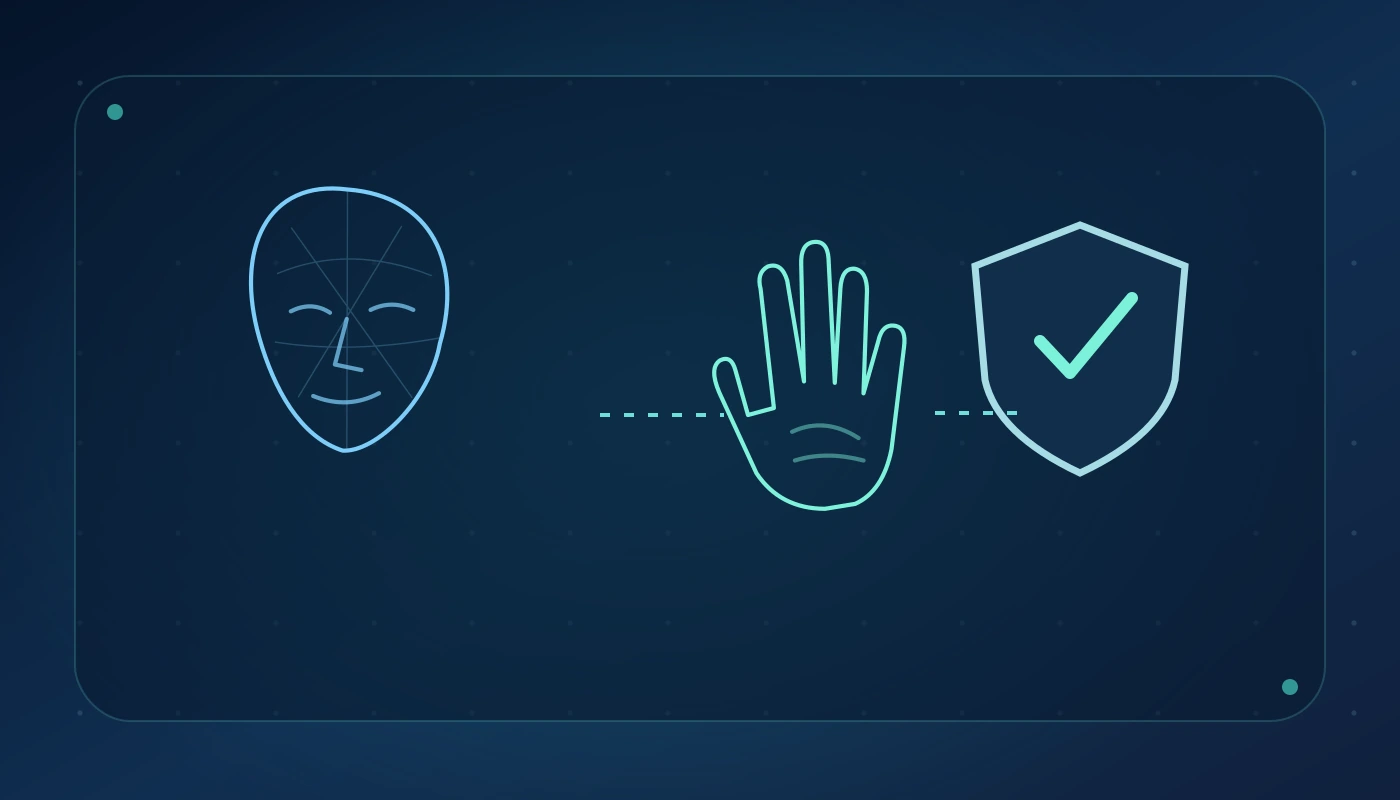
Concept illustration; not a real AttFace UI, verified identification result or customer deployment.
Decide the policy before building the screen
Consider three workflows. A low-risk membership check might use an existing signed-in account and optionally a face confirmation. A private workstation action might use a trusted authenticator and a short 1:1 face step. A high-impact approval might require a possession-bound strong authenticator, transaction confirmation and a separately justified biometric step.
The design should not collect face and palm by default merely because the SDK supports both. The required evidence depends on risk, consent, device availability and the cost of a mistaken decision.
Future architecture illustration. “Face or palm” indicates a policy branch, not a shipped combined AttFace inference API.
Three ways to combine methods
Alternative modality: Face is used by default, with a different enrolled method available when capture is difficult. This can improve convenience and availability, but the fallback must be independently secure.
Sequential step-up: A face result may prompt a second factor or human review when the risk or uncertainty is too high. The second step should answer a meaningful threat rather than simply repeat the same evidence.
Joint decision: Multiple signals contribute to a documented decision policy. This is the most demanding approach because scores may have different scales, errors may be correlated and empirical calibration is necessary. Two favorable scores do not automatically prove one identity.
Keep quality, liveness and matching separate
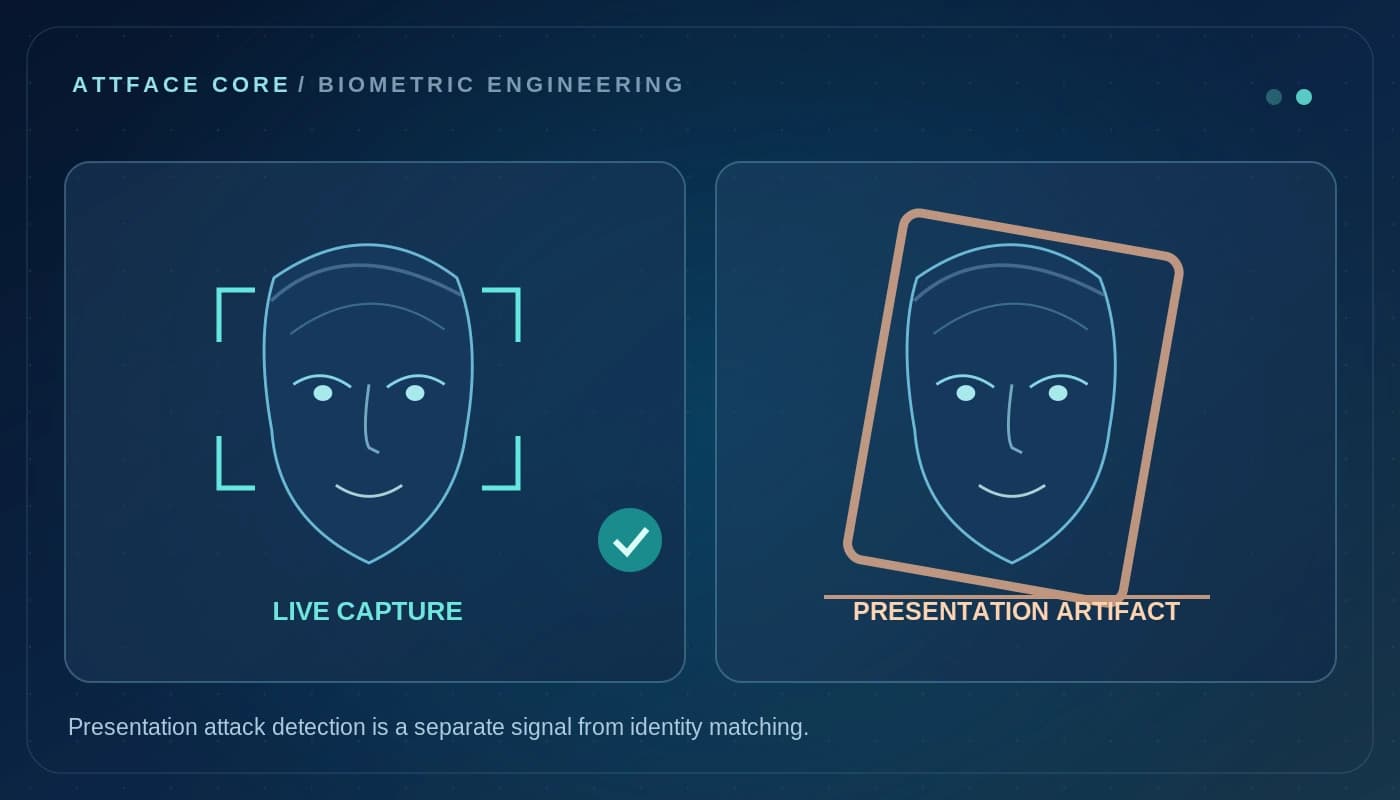
For face, the pipeline can assess the image, presentation attack risk and identity similarity as distinct concepts. A future palm component would need its own equivalent checks. The orchestration layer should be able to distinguish not captured, unusable capture, match inconclusive and policy denied rather than collapsing everything into one number.
This separation improves the user's experience. If a masked face is not usable, the system can offer the agreed alternative. If an enrollment is missing, it can direct the user to a secure setup path. If a policy denies access, it can give a safe and informative explanation without revealing sensitive matching internals.
Make the system testable
Evaluation should cover the complete decision policy, not only a face model or palm model in isolation. Define acceptable false-accept and false-reject rates, retry limits, transaction latency, accessibility outcomes, security controls and operational fallback.
Testing needs representative hardware and realistic conditions. Do not infer improved accuracy solely because a second biometric modality appears independent in a diagram. Measure whether the added branch actually solves the failure cases that matter to your users.
Boundaries, storage and user choice
Every additional modality can increase privacy and security obligations. Separate enrollment consent and retention where appropriate, protect templates, log configuration changes, and make deletion or re-enrollment possible. A non-biometric alternative should exist when required by the application, deployment standard or law.
The system should also resist accidental identity drift: one person must not acquire another person's palm or face template because of an ambiguous prior score. Enrollment and template replacement are high-trust workflows in their own right.
Keep the orchestrator independent of the model
A modular integration can represent each signal with its own capture state, provenance and validity, then let the application's policy engine decide whether it is sufficient. This helps the business platform evolve without embedding business permissions inside biometric inference code. If a modality is unavailable on a device, the orchestrator should know that before prompting the user.
Avoid inventing one universal confidence value that hides incompatible evidence. A security team needs to understand which modality was used, whether the reference enrollment was trusted and which fallback path completed the transaction. That is more useful than a large green percentage.
Pilot decisions in the order they matter
Start by demonstrating a dependable face-only flow under real usage. Log which failures are caused by lighting, pose, device configuration or missing enrollment. Only pursue a second modality when those failures persist and a plausible alternative can address them. Evaluate consent, privacy, hardware cost and support impact alongside technical performance. A roadmap is credible when the architecture supports future signals without claiming they are already delivered.
What this means for AttFace Core partners
The long-term opportunity is a modular verification architecture where the partner's application decides which identity evidence is needed and AttFace provides the face-AI foundation. Additional modalities can be evaluated as extensions instead of being presented as a mandatory replacement.
For SaaS vendors and system integrators, this keeps business rules stable while permitting targeted improvements. Start with a clearly scoped use case, a validated face workflow and a real fallback; add another modality only when the pilot demonstrates value.
Discuss a multimodal research or integration roadmap with AIPractix. The priority is practical reliability and accountable decisions—not a decorative “AI confidence” score.