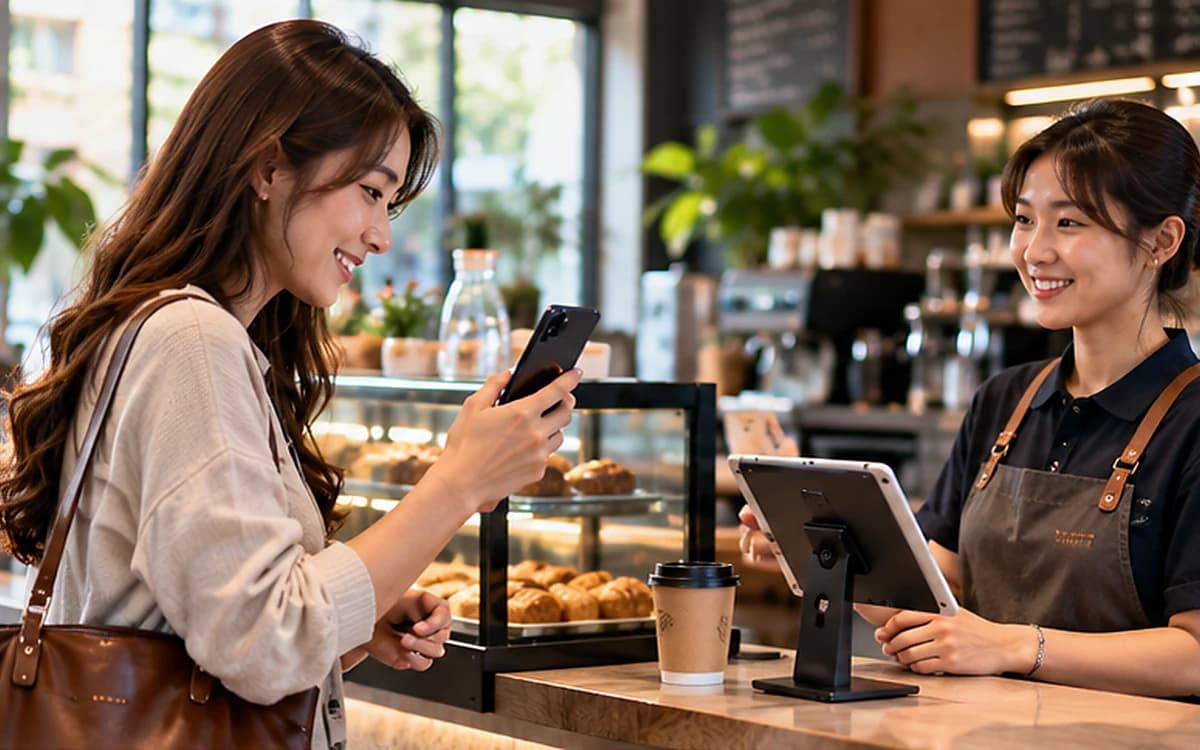
Guests remember a smooth arrival and a friendly welcome, not how sophisticated the camera was. Someone may enter a hotel carrying a suitcase and coffee, while another member walks toward a gym reception with a friend. In both cases, a phone or slender tablet stand can be an unobtrusive part of check-in—if the guest has a clear choice and the experience respects their privacy.
Face verification can support a known guest or member account. It should not mean silently identifying every person who passes through the lobby.
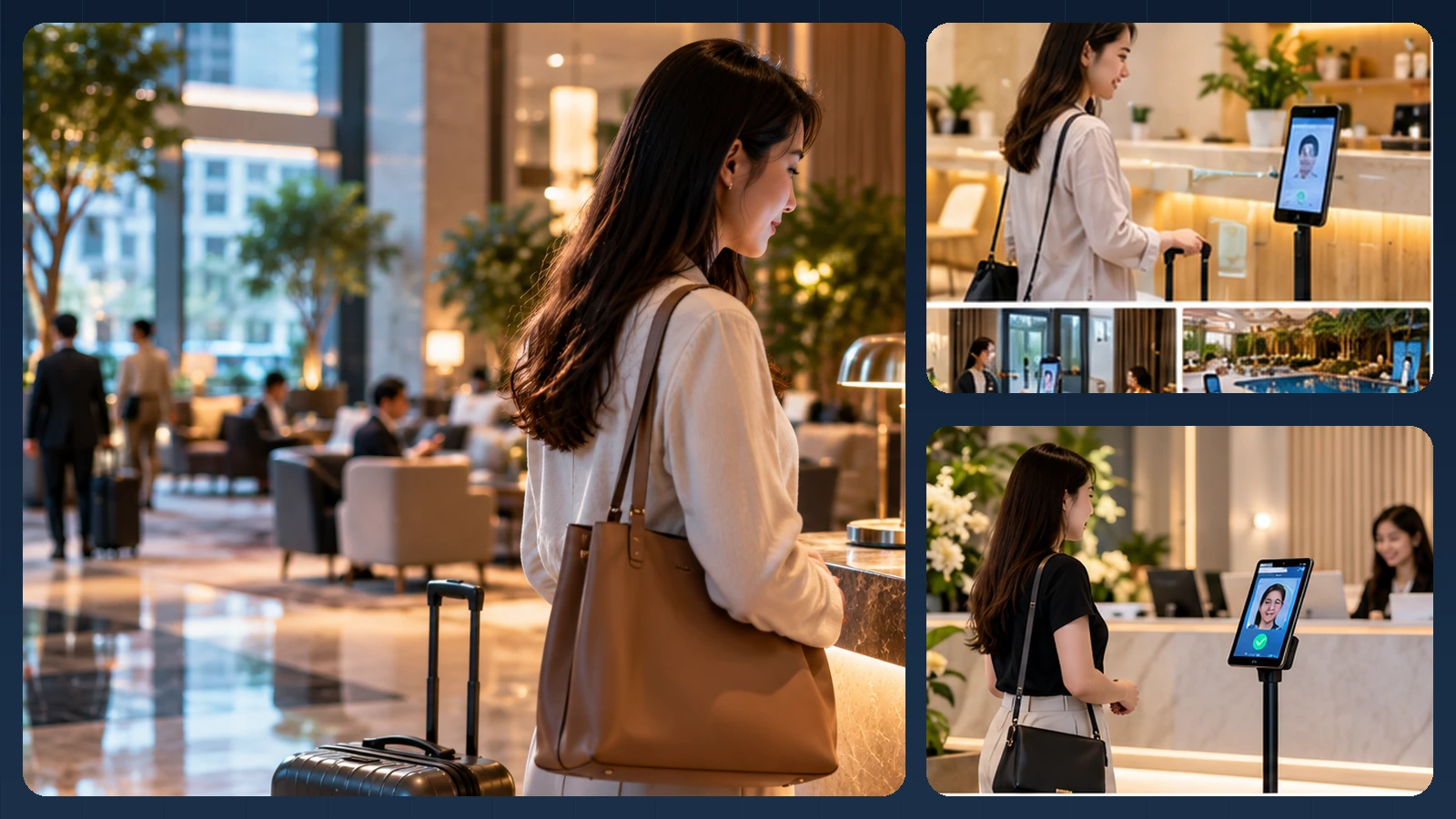
Editorial illustration of a possible experience. Actual UI, device mounts and integrations vary.
From the lobby entrance to a personal welcome
A returning guest approaches reception and enters a booking reference on a tablet stand. With an appropriate notice and enrollment, the platform can offer 1:1 verification against the reference already connected to that reservation. The front desk remains responsible for checking travel documents or legal requirements where applicable, issuing keys and handling billing.
In a membership venue, a customer can check in on an assigned phone or a shared tablet while a friend waits beside them. A good design does not scan companions automatically. Some guests will prefer a card, QR code or staff-assisted process; the service should remain welcoming regardless of whether they opt into biometrics.
How the identity step connects to the business workflow
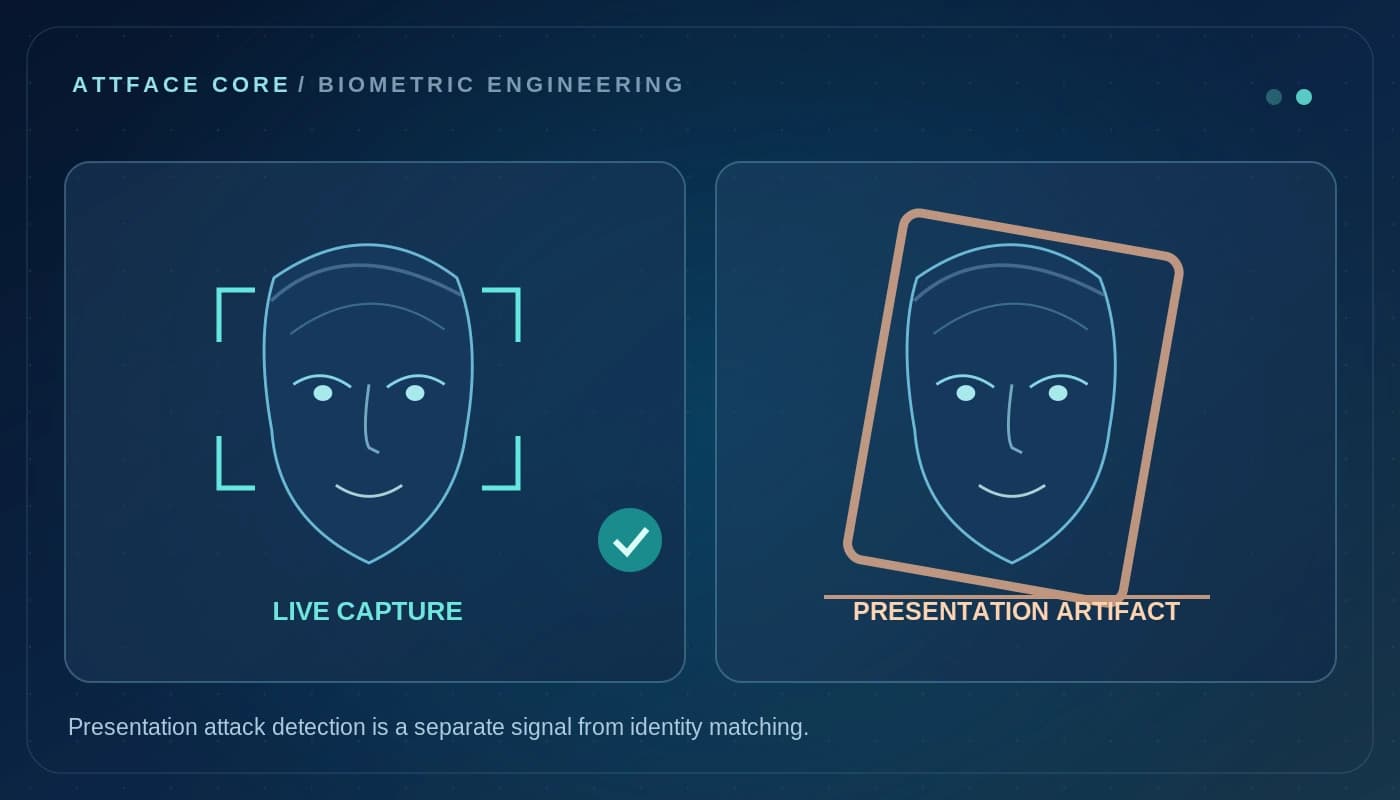
A practical implementation separates the camera interaction, the biometric result and the final business decision. AttFace Core can perform face detection, quality-related analysis, liveness checks where selected, and 1:1 verification or scoped 1:N identification. The partner application decides how to act on those results. Successful face matching alone does not grant access, certify attendance, authorize a transaction or resolve a disputed event.
Conceptual architecture, not a product screenshot or a statement that all pictured integrations are already deployed.
Three thoughtful hospitality scenarios
Hotel return visit. A guest who has previously opted in may choose to verify their identity after claiming a reservation or presenting an appropriate booking reference. The property management system (PMS) then applies its own check-in, payment, legal identification and room-access rules. A face match is not automatically a legal identity document or proof that all check-in obligations are complete.
Club or gym membership. A member can identify themselves through an app, membership number or other identifier, then perform 1:1 verification at an entrance. The membership platform remains responsible for active status, permitted facilities, billing and guest passes.
Staff-assisted premium reception. A guest who has opted into a loyalty experience could use verification as an additional confirmation step. The receptionist stays available when the person prefers a traditional interaction or the camera cannot obtain a clear capture.
These are distinct journeys. A hotel should not assume that a membership enrollment also authorizes surveillance in public spaces or reuse for unrelated advertising.
Why 1:1 is often the right starting point
In hospitality, a claimed booking or membership identifier is usually available. That makes 1:1 verification a practical starting design: compare a fresh capture to the reference associated with the identity the guest has chosen to present. It is more bounded than searching every visitor against a property-wide database.
A 1:N gallery may be considered for narrowly defined, justified workflows, but a passive “recognize everyone walking into the lobby” design raises additional privacy, operational and trust concerns. A friendly user experience should not depend on the broadest possible identification capability.
Guest journey and integration boundaries
A usable opt-in flow might work as follows:
- Explain what face verification does, what data will be retained and what alternatives exist.
- Enroll through an approved process and link the reference to the correct guest or membership ID.
- At check-in, ask for a booking or membership identifier and capture a current face image.
- Run quality checks and 1:1 verification; use liveness controls as appropriate for the threat model.
- Send the result to the PMS, CRM or membership platform for the actual eligibility and service decision.
- If matching is uncertain or the guest declines, use a quick staffed or non-biometric workflow.
Conceptual flow. It does not depict an existing hotel installation or a completed AttFace/PMS integration.
The face engine does not need access to room assignments, payment card data, guest preferences or marketing histories to compare two face references. Keep data interfaces narrow and establish clear service boundaries.
Privacy should feel understandable to guests
A guest may be comfortable with biometric convenience or may prefer not to use it. Both choices should work. Notices should distinguish registration images, any stored face embeddings, live verification captures and operational audit logs. The product team must define retention and deletion, access permissions and any locally applicable legal basis or consent rules.
If a guest revokes permission or deletes their account, there should be a documented route to disable future biometric checks and delete eligible references. A property chain must also decide whether opt-in is site-specific or works across properties; do not silently expand a guest's authorization across brands or geographies.
Children and other vulnerable guests require special caution. Avoid default enrollment of minors and ensure suitable non-biometric options, accessibility support and human review.
Designing for a graceful failure
Lobby lighting may be backlit, a guest may have luggage or wear a hat, and a camera may be temporarily busy. The user experience should offer calm framing guidance and a limited retry, then move promptly to a human desk. A successful recognition score should never be described as a guarantee of real-world identity or entitlement.
The main product metrics are not just model accuracy: measure opt-in adoption, time saved for users who elect the method, first-attempt completion, assistance requests, abandonment, guest complaints and successful deletion requests. Compare these with traditional check-in fairly rather than assuming a biometric kiosk is always the faster path.
What is available today, and what needs integration
This is a potential hospitality or membership integration using AttFace Core. AttFace Attendance is a workforce attendance product and should not be marketed as a completed hotel PMS or loyalty integration. The hospitality partner owns reservations, guest consent, loyalty rules, room access and service personalization; Core contributes only the face-related checks needed by that workflow.
Build the pilot around everyday people and devices
Test the real touchpoints shown in this story: a personally assigned phone, a wall-mounted phone or tablet, and a slim floor stand where appropriate. Include bright windows, colleagues walking together, glasses or PPE where relevant, a failed first capture, and a network interruption when the architecture permits local processing. Record first-attempt completion, retries, recovery time, auditability and administrator corrections—not just a face match score.
Make the next action explicit when image quality or identity confidence is uncertain. A repeat capture, a claimed-ID 1:1 flow, or an authorized assisted alternative is generally more responsible than quietly lowering the threshold. Document data retention, consent or other lawful basis, deletion and access controls for the deployment's jurisdiction.
Next step. Building a hotel PMS, membership or venue application? Discuss an AttFace Core integration that keeps the guest experience optional and welcoming.