A person turns toward the door while their eyes remain on a colleague. Another person keeps their face almost straight but glances at a second monitor. These everyday moments explain why head pose and eye gaze are different signals—and why treating one as the other can damage a product's user experience.
Head pose estimation describes the orientation of a head relative to a camera or another defined coordinate frame. Gaze estimation aims to infer where the eyes are looking, potentially as a direction in 3D or a point on a known surface. This article is about the head-pose side: its geometry, applications and limits in a reusable face AI pipeline.
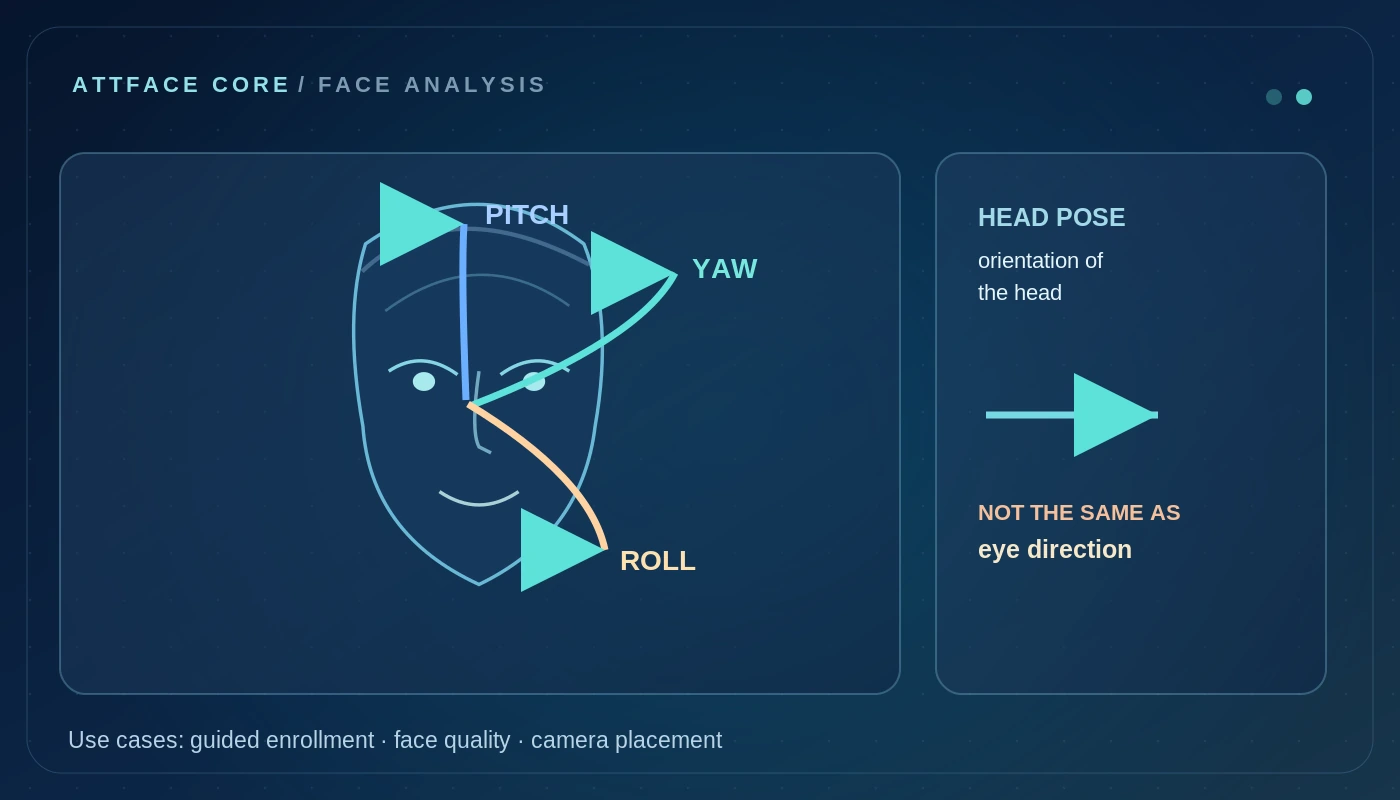
Conceptual illustration, not a live SDK result or independent performance claim.
The three familiar angles
Head pose is commonly communicated as yaw, pitch and roll. Yaw represents a left/right head turn, pitch an upward/downward tilt, and roll a sideways lean. The mathematical sign, axis order and reference frame must be documented; two libraries can report numerically different angle signs for the same visible movement.
The orientation is often estimated from facial landmarks or directly from image features. An application can use these angles to understand whether a face is sufficiently frontal for a task, to guide capture or to observe coarse movement patterns. It does not tell you the exact target of the person's attention.
Diagram shows one proposed integration path, not an eye-tracking or attention-scoring output.
Head pose versus gaze, in one scenario
Picture someone facing a laptop while looking sideways at a notification. Their head pose may remain near frontal; their eye gaze changes. Alternatively, someone may turn their head toward a second screen while their eyes remain momentarily directed forward relative to the head. A head-angle rule such as “yaw greater than 20° equals not looking at the screen” would therefore be a poor gaze detector.
For a technical decision, ask: do you need orientation of the face, or visual line of sight? A head-pose estimator is a natural fit for the former. Eye-region modeling, calibration and scene geometry may be needed for the latter.
Use case 1: Better face enrollment
Many products enroll a new user from a small set of guided captures. Head pose can support instructions such as “turn slightly left”, “turn slightly right” and “look forward”, making the coverage of face orientations more consistent. This is valuable when a partner wants several viewpoints for an authorized enrollment process.
The guidance should be tolerant: rigid angle targets can frustrate users and create low-quality captures. Combine pose with sharpness, face size, illumination and occlusion checks rather than equating a favorable angle with an automatically high-quality identity template.
Use case 2: More informative face-quality feedback
Recognition models often receive images with varying pose. A quality module can use a pose estimate to explain why a frame is unsuitable for a particular comparison. For example, a kiosk could ask a user to “face the camera” if the head is strongly rotated and one eye is mostly obscured.
The acceptance range is product- and model-dependent. Some recognition engines can handle substantial non-frontal pose; others need stricter capture guidance. Set thresholds through representative tests rather than presenting a single yaw number as a universal industry rule.
Use case 3: Guidance in mobile and tablet workflows
When a phone or wall-mounted tablet is slightly above or below the user's eye level, head orientation helps characterize the image being captured. In a check-in application, pose can trigger gentle on-screen hints so users do not need to understand technical camera coordinates. In a shared station, it can also reduce unnecessary failed recognition attempts.
This is an example of the face engine improving experience, not merely producing another analytic number. A prompt should be displayed only when actionable and useful.
Use case 4: Coarse head-motion signals
Some interaction designs use changes in head orientation to support hands-free navigation or capture-time prompts. Head motion may also be one signal in a broader behavior or interaction model, subject to user consent and careful design. The application needs temporal smoothing, missed-frame handling and protection against accidental triggering.
A visible head turn is not proof that a person is distracted, dishonest, fatigued or looking at a prohibited object. Such judgments require different evidence and should never be automated solely from yaw, pitch or roll.
Use case 5: Camera placement and QA
Pose distributions can help a systems integrator evaluate a camera installation. If most intended users appear at high pitch angles, the mounting position may be poor. A few representative, consented test sessions could reveal whether the device placement causes frequent retakes before any model change is required.
This type of operational insight is especially relevant to partner-built face applications: a software improvement may be less effective than moving a camera by a few centimeters.
How landmarks contribute
A facial landmark model estimates key points such as eye corners, nose features, mouth corners and jaw contours. Combined with a suitable 3D face model and camera assumptions, a geometric method can recover head orientation. This exposes pose as an additional use of the same face-analysis pipeline already needed for alignment and quality.
AttFace Core's facial-landmark capability gives partners useful building blocks for such analysis. Exact pose APIs, angle conventions and device-specific validation should be confirmed for the version being integrated. The important message is that landmarks are not just dots drawn on a demo image; they support spatial reasoning about face alignment and movement.
Make head orientation useful, not intrusive
A product can collect face pose to improve a capture experience without building a permanent profile of every head movement. Minimize retention and avoid turning a transient capture-quality signal into covert employee, student or customer monitoring.
Need face landmarks, quality checks or head orientation in your application? Explore AttFace Core and discuss an integration workflow with AIPractix.