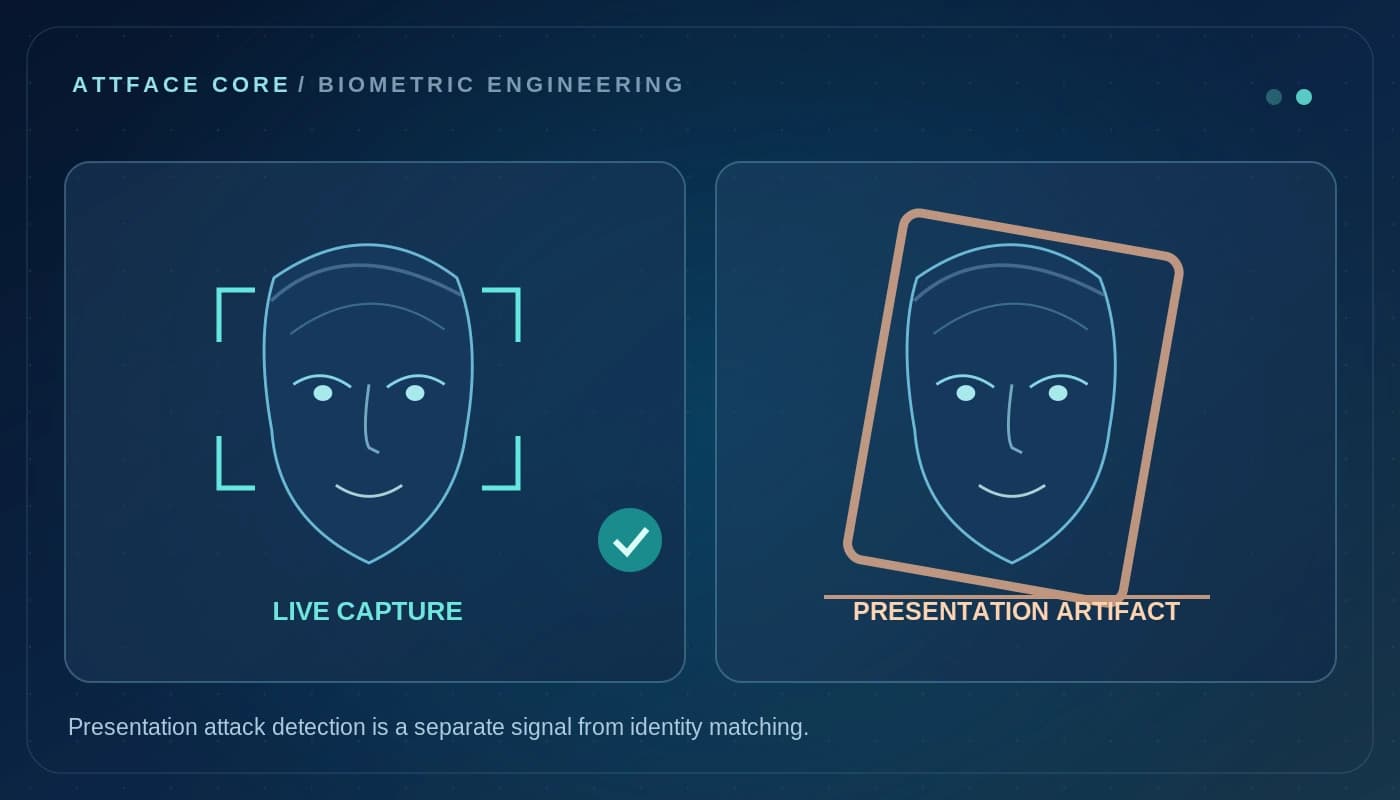
Facial landmarks are often shown in demos as tiny points arranged around the eyes, mouth and jaw. Their deeper value is geometric: they provide 2D observations of the structure of a face. With additional assumptions, those observations can help estimate how the head is oriented in three-dimensional space.
Head pose estimation is a useful engineering example because there are several credible routes to the same output. A team can combine landmarks with classical geometry, predict pose directly from image pixels, or train a multi-task model that learns related outputs together. None of these approaches is universally best; each has different data, deployment and maintenance costs.
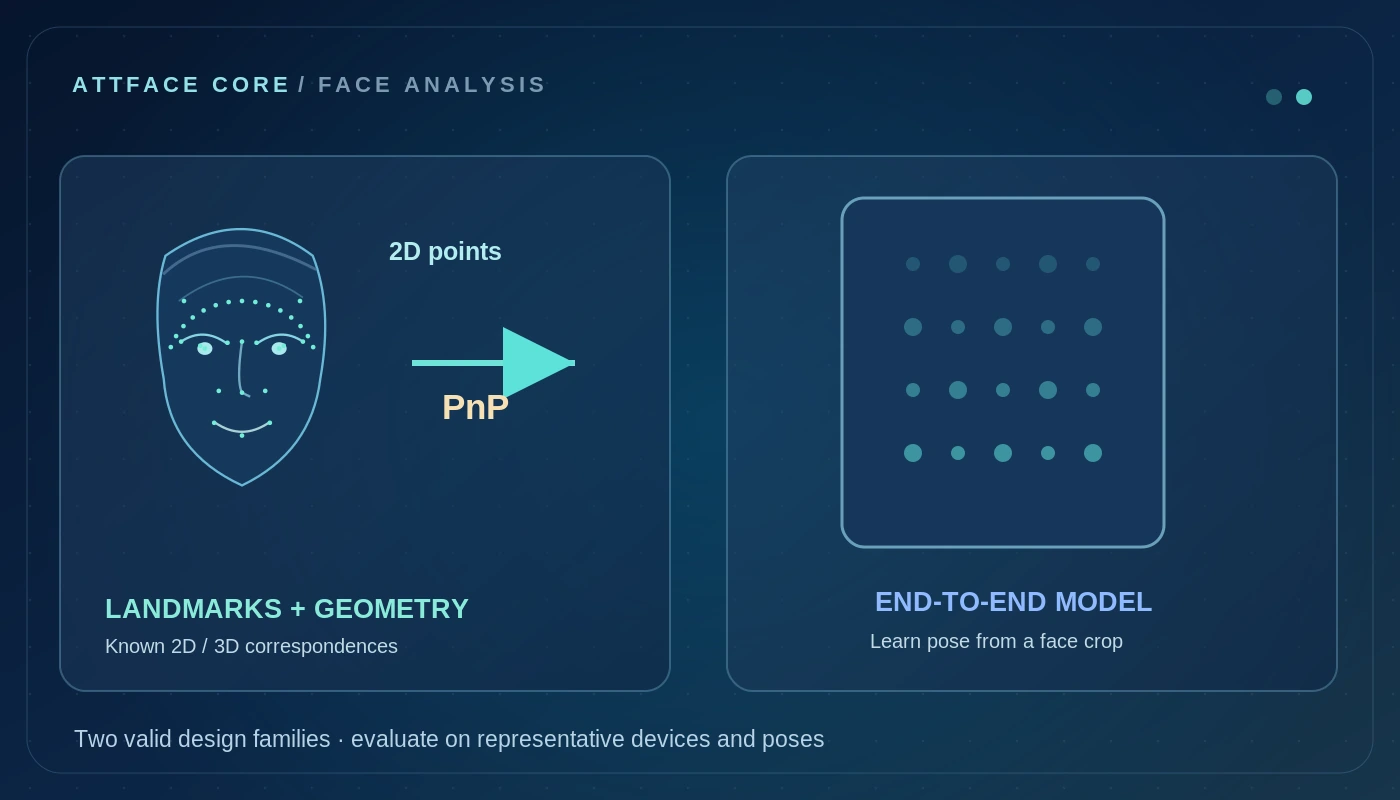
Conceptual illustration, not a live SDK result or independent performance claim.
Define the output before choosing a network
Head pose is commonly represented by rotation relative to a camera coordinate frame, often presented as yaw, pitch and roll. That familiar triplet is convenient for product rules but can be ambiguous if Euler order, angle signs or coordinate conventions are undocumented.
Internally, a model may predict a rotation matrix, axis-angle representation, quaternion or continuous six-dimensional representation. For optimization and evaluation, the full rotation can be more stable than predicting unconstrained Euler angles independently. Convert to yaw/pitch/roll for applications only after defining the convention.
A face model may also estimate translation, but head orientation alone is not a complete 6DoF camera pose. It is important to distinguish the output your team really needs.
Architectural comparison, not an AttFace benchmark or a statement of one proprietary implementation.
Approach A: Facial landmarks plus Perspective-n-Point
The classical geometry path begins with face detection and reliable 2D landmark coordinates. Select landmarks that have corresponding locations on a defined generic or personalized 3D face model. A Perspective-n-Point (PnP) solver then estimates a transformation that projects the 3D reference points toward their observed 2D image locations under a camera model.
In simplified notation, a 3D point X is projected to image coordinates through u ~ K [R | t] X, with camera intrinsic matrix K, rotation R and translation t. The solver searches for pose parameters that reduce reprojection error. Lens distortion and uncertain intrinsics matter, especially for wide-angle mobile cameras.
The basic pipeline is:
- Detect and crop the face; validate minimum face size and occlusion.
- Estimate facial landmarks—for example, a 106-point landmark set where supported.
- Select known 2D–3D correspondences appropriate to a defined facial model.
- Calibrate or approximate intrinsics, then run
solvePnPor a robust variant. - Convert the rotation into the application's documented pose convention.
- Evaluate reprojection error and landmark confidence before accepting the result.
More landmarks do not automatically mean better pose. A well-distributed, stable subset can be preferable to dense points with high uncertainty. A generic face model will not perfectly match every individual; facial proportions, expression, occlusion and annotation quality introduce error.
Why this path is attractive
It is interpretable, fast and can reuse an existing landmark model. When a product already needs landmarks for alignment, this path may avoid training a separate large pose network. It also offers diagnostics such as reprojection error and sensitivity to landmark selection.
Where it becomes difficult
Extreme yaw, occluded features, uncertain camera intrinsics and unusual facial geometry can destabilize the estimate. A solver may return a mathematically plausible orientation that is not clinically or operationally meaningful. Confidence gating, stable landmark selection and tests on real devices are therefore necessary.
Approach B: Direct end-to-end pose regression
An end-to-end approach feeds a face crop into a network trained to predict the head's rotation directly. CNNs and transformer-based models can learn cues beyond a limited set of manually chosen landmarks. Depending on its output layer, the network may predict Euler angles, rotation bins with residuals, a quaternion or a continuous 6D rotation representation that is converted to a proper rotation matrix.
A practical training pipeline requires pose-labeled images spanning the camera, lighting, faces, expressions and rotation ranges expected in production. Label definition is critical: mixing incompatible coordinate conventions creates misleading supervision even when training loss decreases.
Direct methods may perform better in certain occlusions or extreme poses, but that is a hypothesis to test for your own dataset—not an inherent guarantee. They can also incur additional runtime cost and may be harder to debug when an unfamiliar device causes systematic error.
Approach C: Joint landmarks and pose prediction
A third option shares a backbone and predicts both landmarks and pose, possibly with face-quality auxiliary outputs. The idea is to let related tasks improve feature learning while avoiding duplicate inference costs. A different hybrid strategy predicts landmarks and uses differentiable geometric losses or a later PnP step.
Multi-task learning adds complexity: losses must be weighted, labels must be compatible and one task can degrade another. It is often sensible to establish strong single-task baselines before introducing a shared architecture.
| Approach | Strength | Main dependency | Watch out for |
|---|---|---|---|
| Landmarks + PnP | Explainable geometry; reuse landmarks | 2D–3D mapping and intrinsics | Occlusion, landmark error, generic-face bias |
| End-to-end regression | Learns visual pose cues directly | Pose labels and training coverage | Domain shift, rotation representation, runtime |
| Hybrid / multi-task | Shared features and potential efficiency | Coordinated labels and losses | Task interference, debugging complexity |
An evaluation protocol worth trusting
Do not judge a head-pose model only by a few neat frontal examples. Include strong yaw and pitch, roll, occluded eyes, glasses, backlight, low-resolution faces, device rotation and subjects not present in training. Separate validation subjects from training subjects and keep camera/session splits realistic.
Report mean and distributional angular error under a consistent coordinate convention; consider geodesic rotation error when comparing full orientations. Report failure-to-estimate rates and runtime on actual target devices. For PnP, include sensitivity to camera intrinsics and landmark detection failures. For end-to-end models, include cross-device/domain-shift tests.
For time-series applications, assess flicker and latency. Filtering can stabilize a display but may delay real movements; tune smoothing to the task rather than hiding instability in a video demo.
Reusing AttFace Core's 106 facial landmarks
AttFace Core's landmark capability can be a useful starting point for developing geometric head-pose estimation, guided multi-angle enrollment, face-quality rules and alignment-related tasks. A 106-point output is a set of observations, not a universal 3D head model: the team must define landmark semantics, choose correspondences, document coordinate frames and validate the estimator.
A partner might start with landmarks plus PnP as a baseline and only train a direct or multi-task network if data show a meaningful advantage. This is a strong example of why a face engine's intermediate outputs can be valuable beyond the core recognition score.
A practical build roadmap
Start with one camera and a known test set. Establish a geometry baseline. Define a common rotation convention and evaluation script. Introduce a direct model only after understanding the baseline's failure modes. Optimize inference and stabilize behavior on Android, iOS or edge targets if the product requires on-device computation. Finally, document when the pose estimate is unavailable, rather than manufacturing a plausible angle for every frame.
Want to build head-pose analysis on an existing face pipeline? Explore AttFace Core and discuss an SDK or custom AI integration with AIPractix.