Two facial-recognition products can use the same neural network and still solve fundamentally different questions. A mobile app may ask, “Is this the person who owns this account?” A shared kiosk may ask, “Which enrolled person is standing here?” The first is verification, also called 1:1 matching. The second is identification, usually described as 1:N search.
The distinction is not marketing terminology. It determines what data is available at inference time, which errors matter, how a matching threshold should be selected, and what a failed match actually means. If you are choosing a face recognition SDK, this is one of the first architectural decisions to make.

Conceptual illustration, not a live SDK result or independent performance claim.
1:1 verification begins with an identity claim
Imagine an employee using their own phone for a check-in or a customer confirming a high-value account action. The application already knows the expected account or employee ID. It retrieves one authorized reference template for that claimed identity and compares a newly captured face to it.
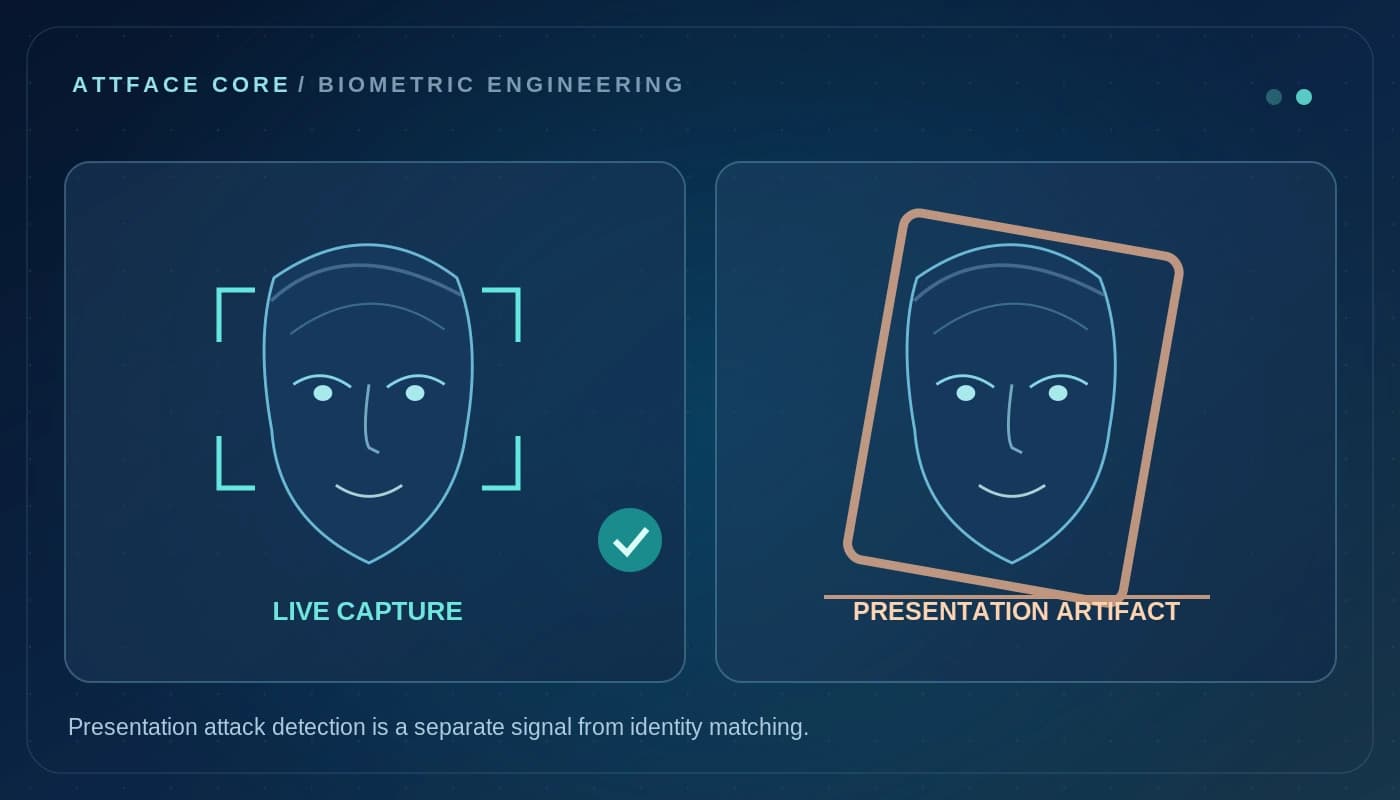
The usual flow is: capture → detect and check image quality → extract the face representation → compare to the claimed account's template → apply a decision policy. If liveness is needed, presentation attack detection (PAD) supplies a separate signal.
The engine typically produces a similarity value or distance. The host application decides whether to accept, reject, retry, request another factor or escalate. A score is not a calibrated probability that the person is genuine unless a separate calibration procedure has explicitly established that interpretation.
Conceptual integration workflow; it illustrates decision stages, not live AttFace benchmark results.
1:N identification begins with an enrolled gallery
At a shared device, users may not enter a name or ID before presenting their face. The application extracts the live face's embedding and searches a bounded gallery of enrolled identities. It may return the best candidate, several ranked candidates or no acceptable candidate.
Open-set identification matters: the person in front of the camera may not be in the gallery. Returning the nearest face unconditionally is therefore unsafe. The system needs a search threshold, a policy for ambiguous top candidates, and an appropriate unknown/retry path. The gallery also needs tenant boundaries so one customer's identities are not searched across unrelated organizations.
A practical implementation may use direct comparisons for smaller galleries or an indexed vector-search architecture for larger ones. Indexing improves scalability but does not remove the requirement to validate recall, latency and end-to-end error at the intended gallery size.
Same embeddings, different operating conditions
A face embedding is a numeric representation learned to support comparison. It is not a human-readable identifier or a cryptographic proof of identity. A verification engine and an identification engine can reuse a compatible embedding model, but their decision calibration should be tested separately.
| Design aspect | 1:1 verification | 1:N identification |
|---|---|---|
| Input identity | Claimed account is known | Identity is not provided |
| Search scope | One reference identity | N enrolled identities |
| Common output | Match / non-match / uncertain | Candidate(s) / unknown / uncertain |
| Core metric family | FMR and FNMR | FPIR and FNIR; rank-based retrieval |
| Common deployment | Employee phone, login, eKYC component | Shared kiosk, authorized member search |
| Key scaling issue | Repeated transactions and device conditions | Gallery size, indexing and candidate ambiguity |
The metric families are not interchangeable. A 1:1 false match rate (FMR) concerns impostor comparisons incorrectly accepted. A 1:N false positive identification rate (FPIR) concerns searches that return an incorrect enrolled identity when no valid candidate should be accepted. NIST publishes separate evaluation tracks for these tasks for good reason.
Why thresholds and gallery size matter
Suppose a similarity threshold works well when comparing a single claimed identity. Searching thousands of enrolled users introduces many opportunities for an unrelated template to receive a relatively high score. The effect depends on score distributions, correlations, model behavior and the gallery, so there is no universal one-line multiplier that predicts production risk.
Choose thresholds using an evaluation protocol that reflects the target scenario: genuine users, non-enrolled probes, expected camera quality, actual gallery sizes and organizational boundaries. Record both error rates and the operational cost of retries and manual review. A fixed number such as 0.80 means little without the model, metric and calibration protocol that produced it.
A helpful interface can display “Please try again” instead of claiming “Wrong person” when the face is partially outside the frame. If the highest two search candidates are close together, the application should not silently choose one without a policy for uncertainty.
Where liveness and quality fit
Image quality and spoof resistance are not synonyms for identity matching. Detection asks whether a face is present; quality checks whether the captured face is sufficiently usable; PAD assesses presentation-attack signals; recognition compares identity-related representations. These are complementary stages.
For a phone-based 1:1 workflow, a local quality check and a single-reference comparison can keep the interface fast. For a shared 1:N station, quality and presentation checks may help prevent unnecessary gallery searches. Neither pattern guarantees security against every attack surface; camera injection, compromised devices and server API abuse still require architecture-level controls.
Choosing the right path for a product
Choose 1:1 when the product already knows the user: a signed-in app, account recovery, step-up authentication, or a claimed-identity onboarding step. Choose 1:N when a limited enrolled population should be recognized without typing an identity, and when there is a legitimate reason to search that gallery. Some products need both: identify a candidate at a shared station, then confirm it using another factor when risk is higher.
AttFace Core is positioned as a reusable face AI engine for partner products. A partner can compose capture, detection, quality, liveness and recognition into a workflow suitable for Android, iOS, edge or server-side architectures, subject to the exact SDK and integration scope. The application owner is still responsible for enrollment, permissions, error handling and policy.
Build the decision, not just the demo
Before a production pilot, specify whether you require verification or identification, the permitted gallery, behavior for unknown people, thresholds, fallbacks, retention, and a representative evaluation dataset. That creates a credible security and user-experience conversation with stakeholders.
Want to integrate 1:1 or 1:N face recognition into an existing product? Explore AttFace Core or contact AIPractix to discuss the SDK architecture and a scoped evaluation.