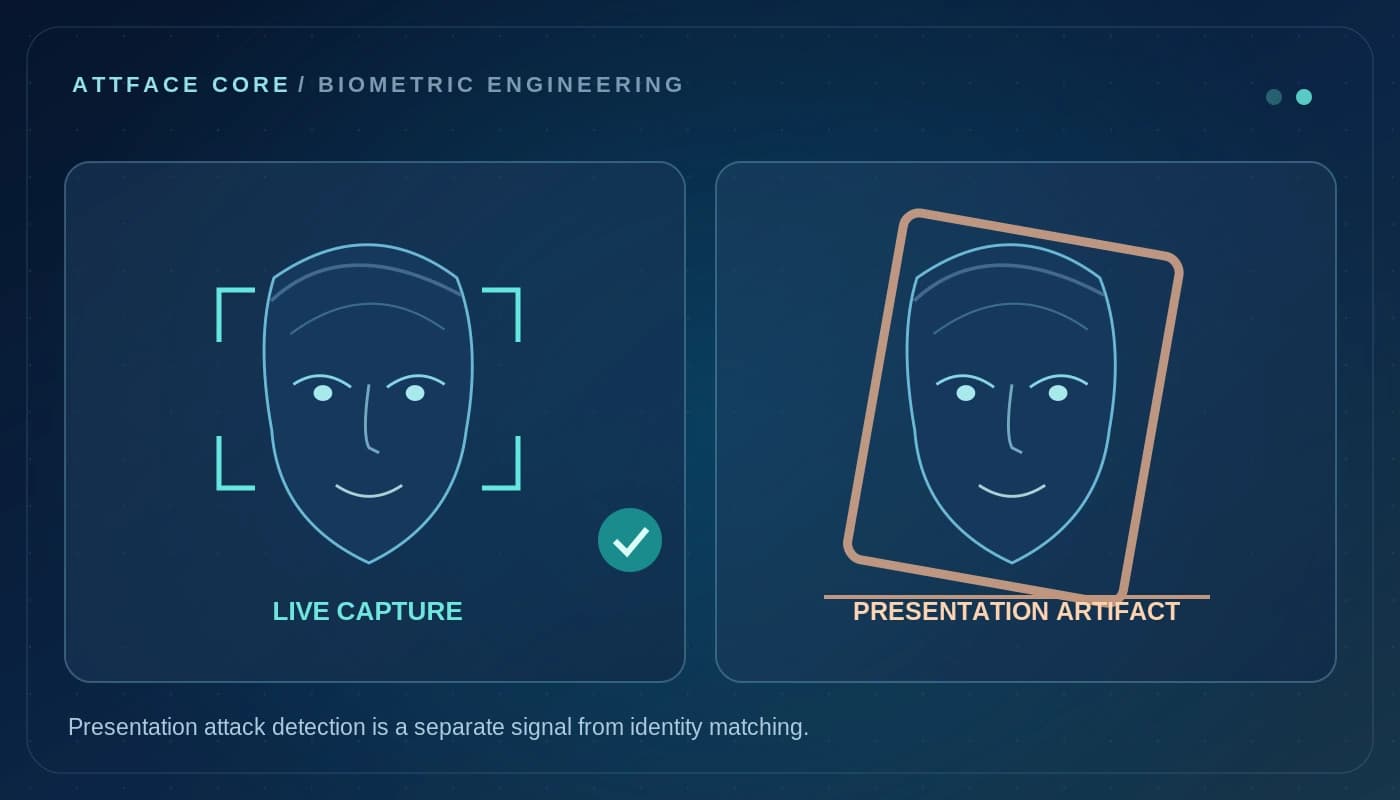
A face recognition system should not be judged only by how often it displays a confident green result. In production, one of the most important capabilities is knowing when not to decide automatically.
Real environments contain backlighting, motion blur, glasses, masks, small faces, unusual angles and imperfect enrollments. A strong face model can still return uncertain evidence under those conditions. The engineering response is to improve the decision flow, not to label every uncertain result as a model failure.
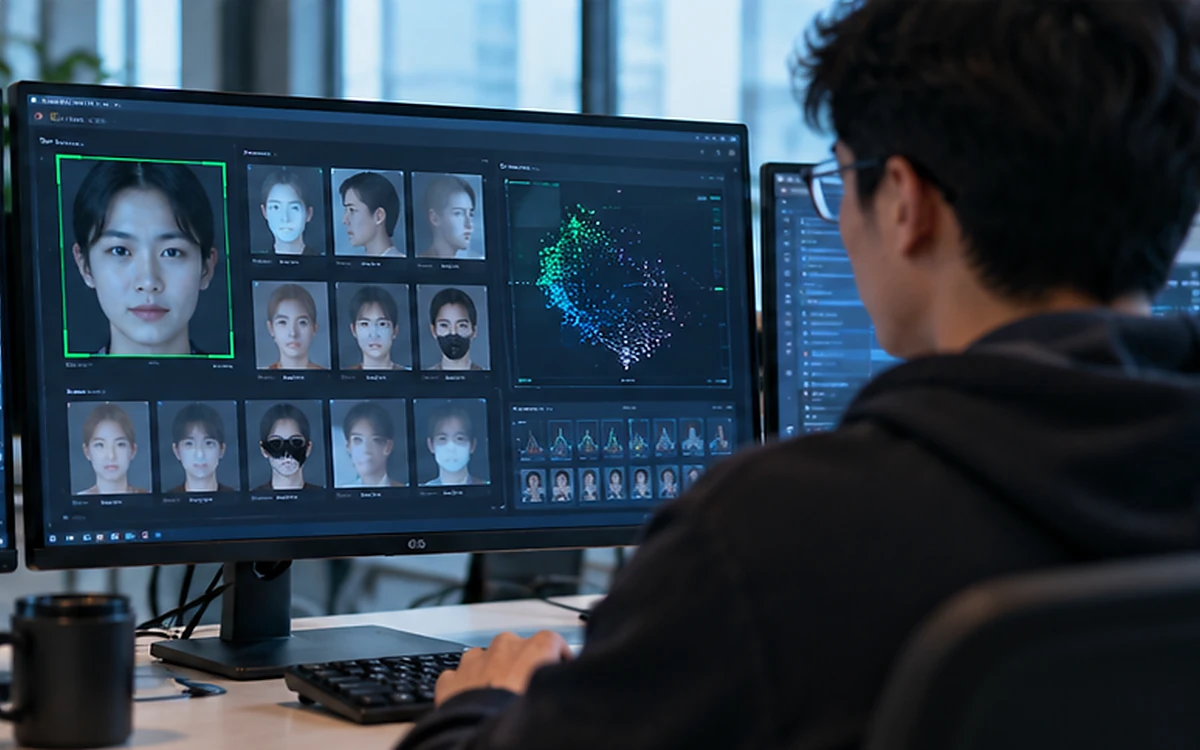
Concept illustration; not a real AttFace UI, verified identification result or customer deployment.
Similarity is not the same as probability
A cosine similarity or model-specific match score measures closeness in an embedding space. It is generally not a calibrated “98% chance that this is the same person.” Converting a raw score into a probability requires a documented calibration method, representative data and the right assumptions.
The application should know whether it is performing 1:1 verification or a 1:N search, since the error characteristics differ. A top candidate from a search is not proof that the candidate is the correct person.
Four signals, four questions
- Face detection: Was a face located in the image?
- Image quality and pose: Is the capture suitable for comparison?
- Liveness / presentation attack detection: Is the input consistent with the expected genuine capture process?
- Face similarity: How closely does the capture match the enrolled reference?
These should remain distinguishable in logs and integration contracts. A low-quality frame can create an unreliable similarity result; a high similarity score does not replace liveness checks; and a liveness signal does not establish a person's identity.
Decision-policy illustration. No numeric score or threshold shown here is a measured AttFace production benchmark.
Design a three-way outcome
Binary success or failure is often too crude. A practical policy distinguishes accept, retry with guidance, and escalate or use an alternative. The exact boundaries should be validated for the application and the cost of a false acceptance versus a false rejection.
For example, poor lighting can trigger capture guidance. A consistent but borderline match may require an additional permitted factor. If several attempts remain ambiguous, the app can move to manual review or an account-based fallback rather than endlessly requesting selfies.
Avoid threshold tuning based on a few good demo photos. Test with representative devices, enrollment conditions and relevant demographic groups, and evaluate both false matches and false non-matches. Document the threshold and policy versions used for each rollout.
Improve upstream evidence before adding more AI
A clean enrollment often improves later verification more than complicated last-minute heuristics. Guide the user through suitable framing, sufficient face size, stable motion and reasonable lighting. Reject unusable enrollment samples and establish a re-enrollment process for genuinely outdated references.
On video, select a usable frame instead of comparing every low-quality frame. On phones, provide simple guidance such as “move toward the light” or “hold the phone steady.” Do not promise that face recognition works perfectly with every occlusion or camera angle.
Where additional modalities may fit
In some workflows, an alternative biometric modality such as palm recognition might make the experience more flexible when the face is unavailable or repeatedly inconclusive. That is an optional architectural direction, not evidence that combining two scores automatically improves accuracy.
Each modality requires its own enrollment, quality controls, spoofing assessment and evaluation. The system also needs a clear fallback when neither modality offers usable evidence. The goal is a more resilient workflow, not a louder confidence number.
Thresholds should reflect decisions, not demos
A single similarity threshold might look intuitive, but an appropriate operating point depends on whether the system is checking one claimed account, searching a gallery or reviewing a regulated high-impact action. Error rates change with the gallery, capture conditions and enrolled population. Study ROC/DET-style tradeoffs where suitable, and validate thresholds using independent evaluation data.
When the decision is uncertain, a new, better-quality capture can add useful evidence. Repeatedly comparing the same bad frame does not. The UX should say what the person can change and give up after a reasonable number of retries.
Treat logs as a diagnostic tool, not a face database
Record stage outcomes, quality reasons, device class, policy version and error taxonomy at the level necessary for support and validation. Do not indiscriminately export face crops or embeddings into generic application telemetry. Protect any necessary audit imagery with purpose-specific access and retention rules. A well-designed diagnostic log makes uncertainty explainable without expanding biometric-data exposure.
AttFace Core as a composable pipeline
AttFace Core exposes the building blocks needed to design face quality, liveness and matching stages as part of an application-owned policy. It does not remove the need to calibrate thresholds and validate the deployment.
Discuss a confidence-aware verification pilot if your product must distinguish genuine identity risk from ordinary capture difficulty.