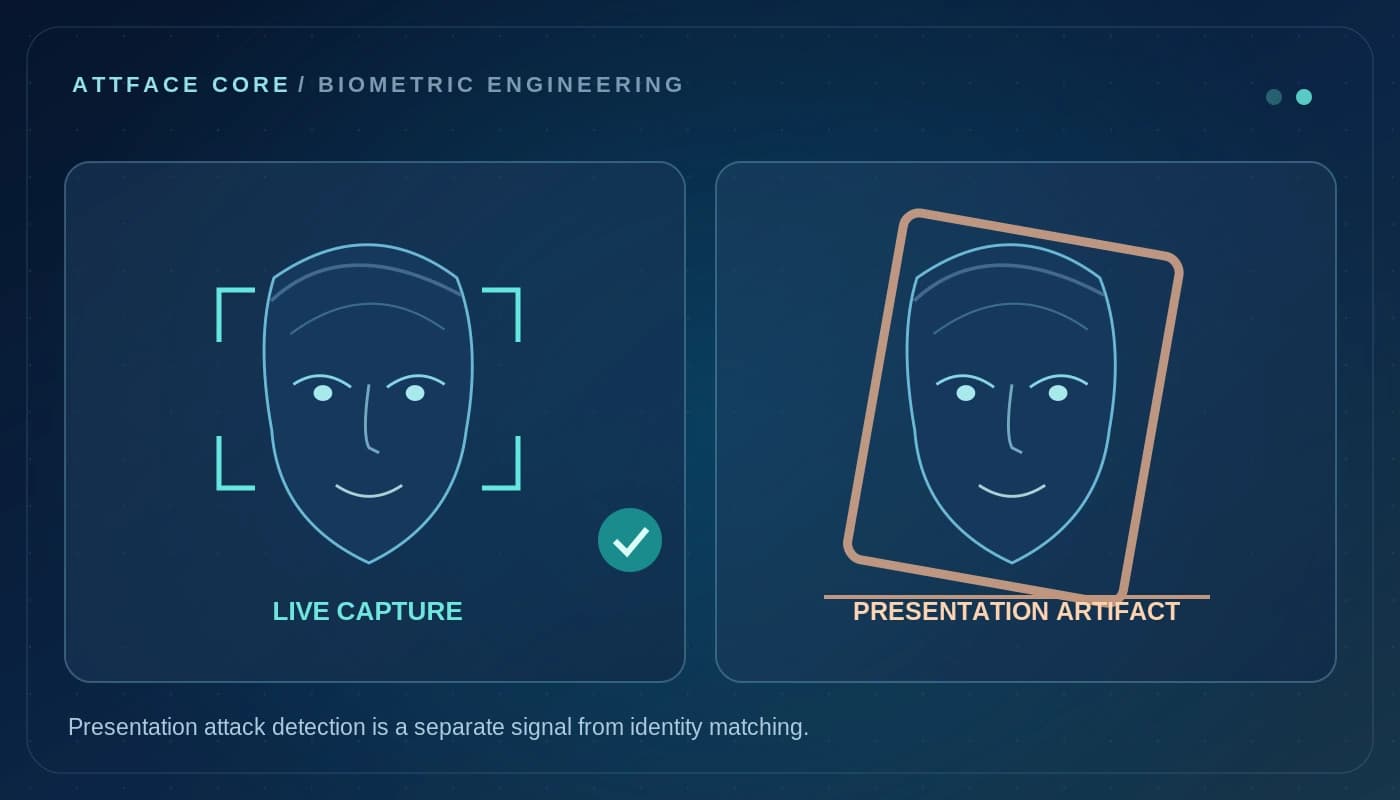
Face recognition is convenient because many mobile devices and cameras already support face capture. In ordinary conditions, an intentional face check can be fast and natural. There are still settings where a face is not easy to capture: protective equipment, face covering, unusual camera placement or a temporary obstruction can make an individual verification attempt inconclusive.
A promising direction is to offer another modality, such as palm recognition, when the environment and hardware make it practical. The purpose is to extend usability and resilience—not to suggest that face recognition is inherently inadequate.
Product status: Palm recognition is discussed here as a potential AttFace ecosystem extension, not as a shipped or validated AttFace Core feature. Technical availability and performance require separate confirmation.
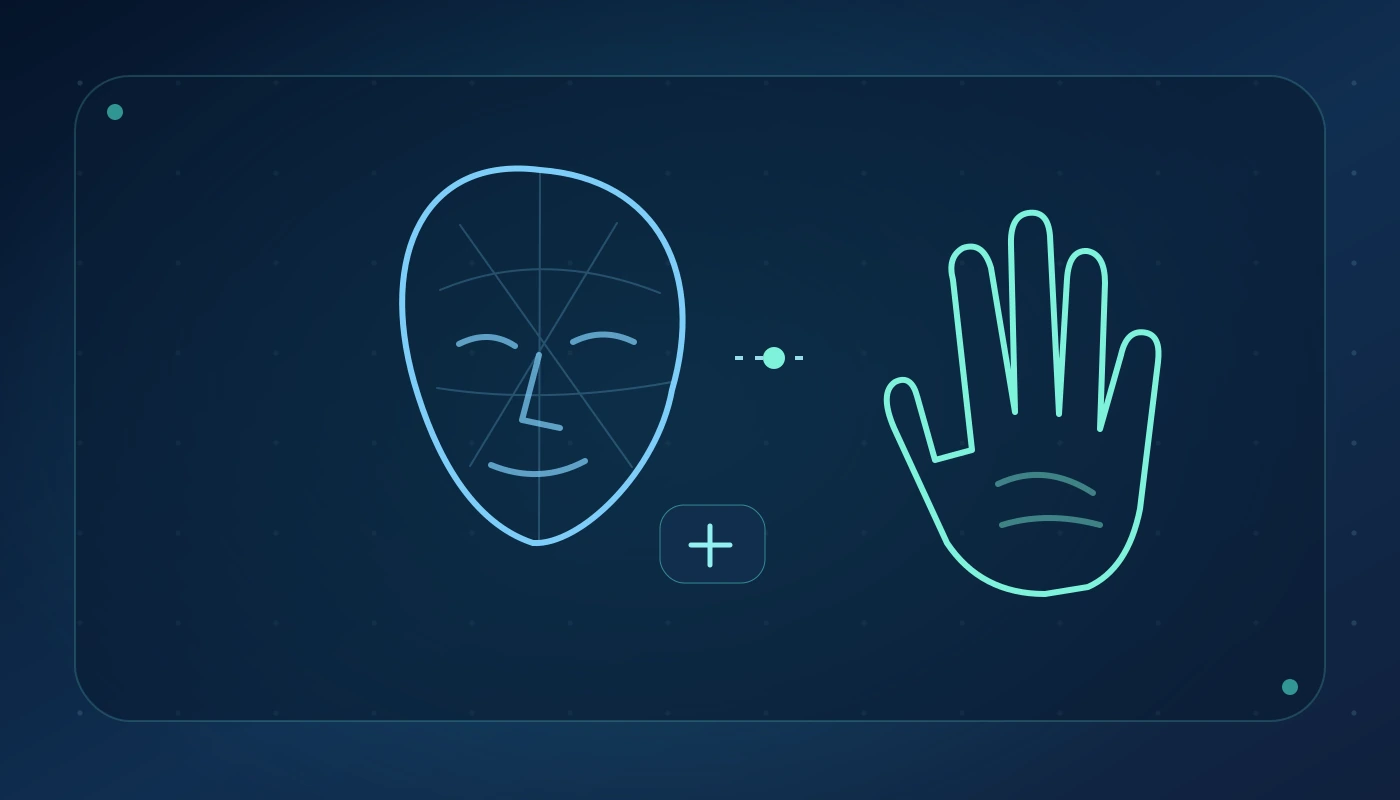
Concept illustration; not a real AttFace UI, verified identification result or customer deployment.
The user experience can offer a choice
Imagine a worker who ordinarily authenticates by face before accessing a permitted service. On a day when their face is partially obstructed by required protective gear, the application may offer a second, enrolled method instead of repeated unsuccessful face attempts.
The flow can explain both choices clearly: use the face if available; use a supported palm method if the face cannot be captured reliably; or continue through a non-biometric alternative when appropriate. A useful alternative is not one that secretly collects two biometrics every time.
Conceptual research architecture; not an AttFace Core performance claim or currently available SDK diagram.
Palm recognition is its own engineering problem
“Palm recognition” can refer to different sensing and matching approaches. Ordinary RGB-camera palmprint processing, near-infrared palm imaging and palm-vein recognition have different hardware requirements, presentation attack threats and enrollment procedures. They should not be treated as interchangeable names for the same model.
A phone camera may be a possible capture device for some palmprint research approaches, but that does not imply reliable operation on every phone or in all lighting conditions. Before productizing a palm pathway, define the exact sensor, user positioning, image quality criteria and supported hardware.
Complementary does not always mean more accurate
Adding a second modality can reduce certain user-experience failures if the failure conditions differ. But it also creates more ways to enroll incorrectly, collect sensitive data or misinterpret evidence. If the system accepts either modality, security may depend on the weaker branch; if it requires both, legitimate users may face additional friction.
Therefore, a dual-modality design needs explicit policy: when does the application choose palm, when does it request both, and what happens when their outputs disagree? Do not add face and palm similarity scores directly unless the scores are calibrated and a suitable fusion method has been validated.
Enrollment, privacy and fallback
Collect only the modalities necessary for a clear purpose and with appropriate consent or other valid legal basis. Give users control over re-enrollment and deletion. Store templates with the same sensitivity as other biometric identifiers and restrict cross-purpose reuse.
Do not use palm as a shortcut around poor face enrollment. First improve face capture quality and matching policy; then test whether a palm pathway provides meaningful additional coverage in the actual environment.
What a responsible pilot would establish
A pilot should compare face-only, palm-only and proposed combined decision paths. Measure false matches, false non-matches, failure-to-acquire rates, spoofing resistance, latency, user preference and performance across relevant conditions. Evaluate hardware costs and training effort as well as model metrics.
There is no universal “accuracy gain” that can be promised before those measurements. In some settings the second option may mainly help accessibility and operational continuity rather than maximum accuracy.
Picking the right palm signal
Before model selection, decide whether the use case needs a printable palm surface pattern, a contactless image or a specialized vein-sensing approach. The available camera and lighting determine what data can be acquired. Hand hygiene requirements, gloves, physical accessibility and gesture comfort can all matter more than the theoretical feature representation.
A useful engineering study begins with acquisition repeatability: can ordinary users reproduce the required hand pose quickly on the intended device? Only then does it make sense to compare embeddings and optimize matching. Overstating palm support too early risks committing the product to hardware that customers do not have.
Fallback policies need security review
The alternative method should not become a weaker shortcut for an attacker. A face-or-palm policy requires separate validation of the palm branch; a face-and-palm policy introduces additional failure and enrollment burden. Product managers should describe the real objective—availability, accessibility or assurance—before choosing a policy. All of these questions remain research decisions until field data is available.
Roadmap: flexible identity rather than a new gadget
The strategic value for AttFace is an engine that can support additional signals through a clear interface while keeping face recognition central and mature. Partners would continue to own user enrollment, authorization and business policy, with modalities added only where they solve a specific problem.
Talk with AIPractix about a feasibility study if a face-plus-palm workflow fits your device environment and you want to test its practical benefits before deciding on a product roadmap.